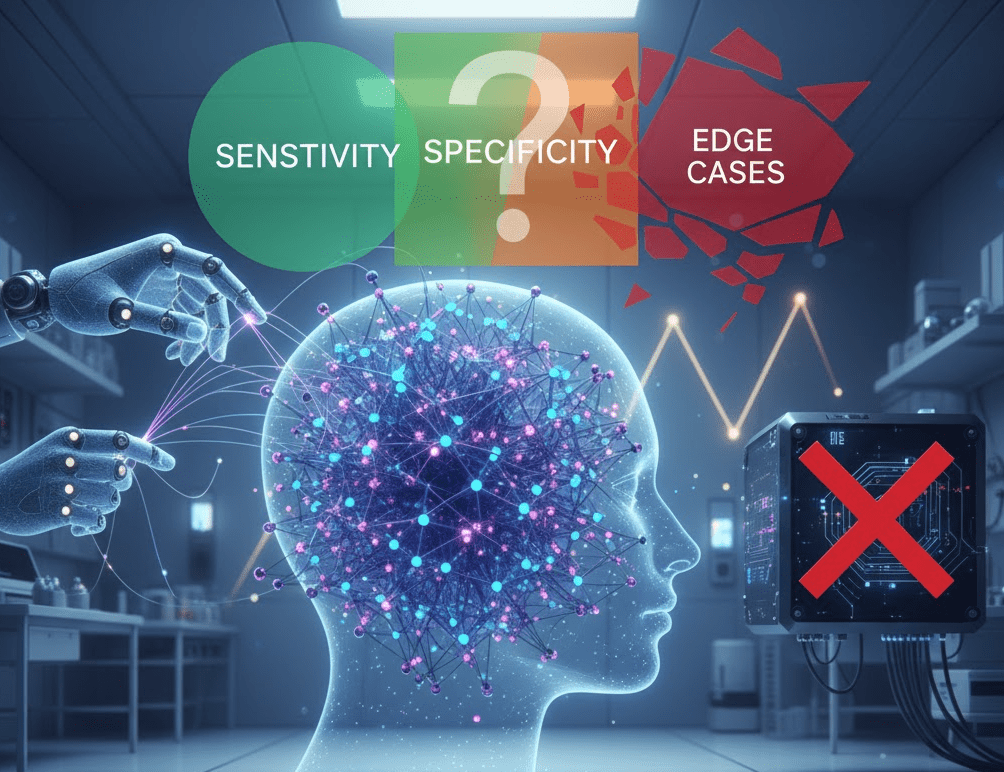
The pursuit of objective biological markers in psychiatry has long been considered a critical frontier for improving the accuracy of mental health diagnostics. Traditional diagnostic methods for conditions such as bipolar disorder rely heavily on clinical observation and patient self-reporting, which can be complicated by overlapping symptoms. Recent advancements in machine learning have ignited hope that structural and functional neuroimaging can provide a more reliable, objective framework for diagnosis. The ENIGMA Bipolar Disorders Working Group and researchers at the University of Iowa have demonstrated the potential of using structural magnetic resonance imaging and multi-modal data to supplement clinical judgment. However, as these technologies move closer to clinical application, it is vital to understand that a single accuracy metric is an insufficient measure of success.
The Illusion of Global Accuracy
In the field of machine learning, researchers often point to the Area Under the Curve of the Receiver Operating Characteristic as a primary indicator of model performance. While a high AUC value suggests that a model can generally distinguish between two groups, it often fails to represent the practical nuances required for clinical decision making. The AUC is an aggregate measure of performance across all possible classification thresholds, essentially summarizing the model’s ability to rank a random positive instance higher than a random negative one. However, in a clinical setting, a model is not used as a ranking tool across a population; it is used as a binary classifier for a specific individual.
Global accuracy metrics can be highly misleading when they are driven by a model that is excellent at identifying healthy controls but poor at the far more difficult task of differential diagnosis. For instance, the ENIGMA consortium found that while individual sites could reach accuracies over 80 percent, aggregate multi-site models often settled between 65 percent and 72 percent. This variability suggests that high accuracy in one controlled environment does not necessarily translate to a universal diagnostic tool. Furthermore, the AUC can mask a model that performs poorly at the specific cut-points required for clinical safety. A model might boast an AUC of 0.85, yet at the high-specificity threshold required to avoid misdiagnosing healthy individuals, its sensitivity might drop to levels that are clinically useless.
The Clinical Reality of Sensitivity and Specificity
For a diagnostic tool to be useful in a psychiatric setting, it must balance the two competing priorities of sensitivity and specificity. Sensitivity refers to the ability of the model to correctly identify every true case of a condition. In the differential diagnosis between bipolar disorder and major depressive disorder, low sensitivity results in false negatives. This is a significant clinical risk because a missed diagnosis of bipolar disorder may lead to the administration of antidepressants without mood stabilizers, which can inadvertently induce mania. Specificity, on the other hand, measures the ability of the model to correctly identify those who do not have the condition. Low specificity leads to false positives, which can result in unnecessary stigmatization and exposure to the side effects of medications like lithium or antipsychotics.
There is an inherent statistical trade-off between these two measures. As one attempts to increase sensitivity to ensure no cases are missed, the number of false positives inevitably rises, decreasing specificity. The ROC curve illustrates this trade-off, and the AUC represents the overall strength of the model across this spectrum. However, the best cut-point on the curve is rarely the one that maximizes total accuracy. Instead, the optimal threshold is dictated by the clinical cost of misclassification. In psychiatry, where the consequences of a false positive diagnosis can be life-altering and the risks of a missed bipolar diagnosis are severe, a model must be tuned with extreme care. A high AUC does not guarantee that a clinically acceptable cut-point even exists on the curve. If the curve is shaped such that high sensitivity can only be achieved at the cost of unacceptably low specificity, the model remains clinically unviable regardless of its aggregate score.
The Limitations of Structural and Chemical Data
Modern research utilizes a wide array of derived measures from neuroimaging, including regional cortical thickness, subcortical volumes, and white matter integrity. Studies have identified statistically significant group differences, such as reduced cortical thickness in the left pars opercularis and the fusiform gyrus in individuals with bipolar disorder. Despite these findings, the distributions of these physical traits often overlap significantly between healthy individuals and those with the illness. This means that while a group average might show a difference, an individual scan may not provide enough distinct information to confirm a diagnosis. The effect sizes seen in large-scale studies like ENIGMA are often modest, meaning the biological signal is subtle compared to the noise of individual variation.
Even when combining multiple modalities, such as T1-weighted, T2-weighted, and Diffusion-Weighted Imaging, the biological signature often falls short of meeting any diagnostic criteria. The study by Deng and colleagues at the University of Iowa highlighted that while multimodal data improves identification, we are still far from a gold standard biological test, if one is even possible. Brain structure and chemistry should be viewed as supplemental indicators rather than primary diagnostic evidence. The brain is highly plastic, and structural variations can be influenced by medication, age, and even lifestyle factors, making it difficult to isolate the primary markers of the illness from secondary effects.
The Challenge of Edge Cases
Machine learning models generally excel at identifying the most common patterns within a dataset, often referred to as the centroid of the data. However, clinical psychiatry is defined by its outliers and edge cases. Patients with late-onset bipolar disorder or those with rare neuroanatomical variations often present unique combinations of features that do not align with the average training data. Moreover, the influence of comorbid conditions on the very features that differentiate between those with bipolar disorder and controls is increasingly well-documented. These individuals represent the high-risk long tail of the population where diagnostic uncertainty is greatest and the need for objective tools is most acute. Unfortunately, because these cases are rare, they exert very little influence on the model’s overall accuracy or AUC during the training phase.
Furthermore, machine learning models can struggle with non-linear interactions between variables. A specific reduction in hippocampal volume might only be a relevant predictor when it occurs alongside a specific white matter hyperintensity or a specific neurochemical ratio derived from magnetic resonance spectroscopy. Because these unique interactions are rare and complex, they are often ignored by models optimized for global performance. This results in a system that may be highly accurate for the textbook cases but fails precisely when the clinical situation is most complex. This failure at the margins is particularly problematic in psychiatry, where comorbidity and atypical presentations are the rule rather than the exception.
Site-Specific Variance and the Generalizability Gap
One of the most significant hurdles in clinical AI is the presence of site-specific variance and batch effects. Research conducted across multiple cohorts has shown that a model developed at one university may perform at an 80 percent accuracy level, yet drop to near-chance levels when applied to data from a different scanner or a different demographic. This lack of generalizability mirrors the differences between academic studies, where one team identifies a specific brain region as a key marker while another team finds no significance in that same area. This heterogeneity is not just a technical nuisance; it is a fundamental challenge to the validity of neuroimaging-based machine learning.
The lack of consensus on which markers are actually important contributes to a deep skepticism regarding the clinical utility of these models. When meta-analyses and multi-site studies like ENIGMA fail to find consistent, high-magnitude markers across all populations, it suggests that the “features” identified by small-scale studies may be idiosyncratic to their specific sample or imaging hardware. This heterogeneity often fails to align with reported feature importance. A model might claim that the amygdala volume is the most important feature for its predictions, yet when that model is applied to a new dataset, the amygdala may have no predictive power at all. This discrepancy suggests that the model may be over-fitting to noise or site-specific artifacts rather than learning the true underlying biology of the illness.
Feature Importance and the Black Box Problem
Feature importance is often touted as a way to peek inside the “black box” of machine learning, providing a list of which variables contributed most to the model’s decisions. While this is a critical measure for model transparency, it does not truly solve the black box problem. Knowing that a model prioritizes certain regions of the prefrontal cortex does not explain how those regions interact or why the model interpreted a specific combination of measurements as a positive diagnosis. Feature importance tells us which buttons the model is pushing, but it doesn’t reveal the internal logic of the machine.
In many cases, high feature importance can be misleading. A model will often assign high importance to a feature that is actually a proxy for a confounding variable, such as long-term medication use, rather than the primary pathology of bipolar disorder. Furthermore, feature importance measures often fail to capture the complex, high-dimensional interactions that drive the most accurate predictions. Because the mind and brain are inherently multi-scalar and dynamic, reducing their complexity to a ranked list of independent features is an oversimplification that can lead to a false sense of security, as well as ignore interactions between them, where careful feature engineering is most important.
Human-in-the-Loop Diagnostics
The future of machine learning in psychiatry lies not in replacing clinicians, but in augmenting them. We must move beyond the black box approach of asking if a model is accurate and instead ask where and why it is failing. Clinicians must play a central role in feature engineering, ensuring that the data points analyzed by the model represent meaningful biological pathways rather than random statistical noise. This requires a shift from purely data-driven approaches to more hypothesis-driven machine learning, where the features are grounded in our existing understanding of neurobiology and clinical science.
The machine learning output should be viewed as one piece of a larger diagnostic puzzle, serving as a biotype indicator that informs, but never dictates, the final clinical judgment. This human-in-the-loop approach acknowledges that even if a model could reach perfect accuracy in predicting a brain state (an already impossible scenario), it would still not equal a diagnosis. Mental illness is a holistic experience that involves subjective distress, environmental factors, and behavioral patterns that an MRI scan cannot capture. By integrating the objective, high-dimensional processing power of AI with the subjective, contextual expertise of a trained clinician, we can create a diagnostic process that is more than the sum of its parts.
Conclusion
High accuracy, AUC and feature importance values are statistical starting points, but they are not clinical finish lines. In neuroimaging-based psychiatry, accuracy is a responsibility that requires a deep understanding of the individual behind the data. The current heterogeneity between studies and the lack of consensus on diagnostic markers remind us that we are still in the early stages of this journey. Progress will move us toward models that respect individual biological variance and the complexities of the human mind rather than just the broad patterns of the crowd. By prioritizing sensitivity, specificity, and the rigorous validation of edge cases, we can move machine learning from the laboratory to the clinic in a way that is both safe and effective. The goal is not to find a magic algorithm, but to build a robust, transparent, and generalizable tool that truly serves the needs of the patient when informed in the proper context.
References
Calesella, F., Colombo, F., Bravi, B., Fortaner-Uyà, L., Monopoli, C., Poletti, S., Tassi, E., Maggioni, E., Brambilla, P., Colombo, C., Bollettini, I., Benedetti, F., & Vai, B. (2024). A machine learning pipeline for efficient differentiation between bipolar and major depressive disorder based on multimodal structural neuroimaging. Neuroscience Applied, 3, 103931.
Deng, L. R., Harmata, G. I. S., Barsotti, E. J., Williams, A. J., Christensen, G. E., Voss, M. W., Saleem, A., Rivera-Dompenciel, A. M., Richards, J. G., Sathyaputri, L., Mani, M., Abdolmotalleby, H., Fiedorowicz, J. G., Xu, J., Shaffer, J. J., Wemmie, J. A., & Magnotta, V. A. (2025). Machine learning with multiple modalities of brain magnetic resonance imaging data to identify the presence of bipolar disorder. Journal of Affective Disorders, 368, 448-460.
Nunes, A., et al. (2020). Using structural MRI to identify bipolar disorders – 13 site machine learning study in 3020 individuals from the ENIGMA Bipolar Disorders Working Group. Molecular Psychiatry, 25, 2130-2143.
 Intercept Analytics